Pages

Thursday, November 19, 2020

What do J.K. Rowling’s Harry Potter and Emily Brontë’s Wuthering Heights have in Common?

Fans of the Harry Potter franchise may recall that Harry Potter and the Sorcerer's (Philosopher's) Stone kicked off the film series in September 2000 with a final scene at Hogsmead Station. Hagrid waves goodbye to the students, having lived through their first year at Hogwarts. The scene foreshadows the future as they continue their magical journey.

Hogsmead Station actually exists, but it's otherwise known to North Yorkshire, England residents as Goathland Station. Goathland is en route on the North Yorkshire Moors Railway, one of their beloved heritage railways.

Book Cover

Warner Brothers Studio London

Though Harry Potter and Wuthering Heights were written more than 150 years apart, they share a setting in West and North Yorkshire, in which nothing kindles the imagination so utterly as the wild and untamed moorlands. I can attest to this, since I have been there several times. 

The first time I visited the Yorkshire moors, I was 17 and a student at the United World College of the Atlantic in Wales. I had to write an English Literature paper for the International Baccalaureate (IB) degree and chose Emily Brontë and Wuthering Heights as my subject. The academic work was a wonderful excuse to spend a school project week in Yorkshire.

Book Cover

Brontë Parsonage Museum, Haworth

Yorkshire Moors

My romantic notions blossomed as the train pulled into York. I found a bed and breakfast, and the next day took a bus to Haworth, the home of the Brontë Parsonage Museum. 

The tour of the museum and surrounding moorlands held my spirit spellbound. For as I walked the moors on that drizzly day, I happened upon a blind old man with a cap and a cane whose ancestors knew the Brontës. He delighted me with his stories and intrigued me with his words about life on the moors. 

Old Man Walking Away

Over the years, scholars of English literature have tried to interpret the milieu Emily created with such passion and sometimes violent intensity. When Wuthering Heights first appeared on shop shelves, many thought the story too "vulgar" (not refined). Others since have cast the story as a spiritual metaphor. Postmodern scholars congratulate her for being a feminist before her time. I'm not sure any of them got it right.

My own encounter with the old man proved to enhance my experience and gave me a small glimpse into Emily's world of Wuthering Heights. He told of cold bleak winters and mild green summers, the forces of nature and an awareness of the supernatural that life on the moors elicits. These are compelling and repulsive at the same time--like Heathcliff and Catherine.

I believe her sister Charlotte came closest to interpreting her sister's work in an 1850 preface to the book long after Emily had died at age 30. I give only snippets to save time and space:

"I have just read over Wuthering Heights, and...have gained a definite notion of how it appears to other people--to strangers who knew nothing of the author...unacquainted with the locality where the scenes of the story are laid; to whom the inhabitants, the customs, the natural characteristics of the outlying hills and hamlets...are things...unfamiliar...It is rustic all through. It's moorish, and wild, and knotty as a root of heath...her native hills were far more to her than a spectacle; they were what she lived in...circumstances favoured and fostered her tendency to seclusion; except to go to church or take a walk on her hills...Her imagination, which was a spirit more sombre than sunny, more powerful than sportive, found in such traits material when it wrought creations like Heathcliff, like Earnshaw, like Catherine. Having formed these beings, she did not know what she had done..."

And therein lies the mystery, the moors, the magical journey...

For my part, whether Emily knew it or not, she wrote one of the most evocative tales of the duality in all of us--the capacity to exercise great good and effect extreme evil. Walking the wild and untamed moors somehow allows one to ponder these things of humanity, God, and the universe.

Wednesday, November 11, 2020

Veterans Day: A Day to Say Thank You!

By now you're probably aware today is Veterans Day, if you live in or are a citizen of the United States. If you've Googled anything in the United States, you've seen an interesting rendering of what looks like an American Flag on the homepage.

But why do we celebrate Veterans Day?

Originally called Armistice Day, it was declared in celebration of the end of World War I, "the war to end all wars," when the Treaty of Versailles was signed on June 28, 1919 between Germany and our allies. In reality, the fighting had ceased on November 11, 1918. But after World War II and the Korean War, President Eisenhower signed the name-change into law on June 1, 1954. The specific day of celebration has changed through the years, but at the urge of veterans, the day came back to rest on November 11th.
 
A visit to the US Department of Defense website gives a brief history of this federal holiday and reminds the viewer that the correct way to spell Veterans Day is without the apostrophe, because "veterans" applies to all--not just one--veterans who have served "the country in war or peace -- dead or alive -- although it's largely intended to thank living veterans for their sacrifices." 

But what sacrifices have men and women and their families made over the generations and why?

My father, Joseph S. Chonko, WWII

Dad, Home on Leave, WWII

In 2003, our family made a trip to Washington D.C., among many other places such as Gettysburg and Boston, tracing our nation's historical roots on the East Coast. 

On the steps of the Capitol

Of note in the picture above, the statue on the top of the Capitol is referred to as the Statue of Freedom and is considered the "crowning feature of the Dome of the U.S. Capitol" by the Architect of the Capitol website. She stands 19 feet 6 inches tall and weighs 15,000 pounds on a cast iron pedestal.

Designed by Thomas Crawford before he died in 1857, the statue was erected in 1863. Though the architect of the Capitol Thomas U. Walter originally proposed a Goddess of Liberty, Crawford suggested an allegorical figure of Freedom Triumphant in War and Peace.

The U.S. Capitol Visitor Center describes her as wearing "a helmet encircled with stars and topped with an eagle's head and feathers, the talons hanging at either side of her face. Her long, curly hair flows down her back. Her dress is secured with a brooch with the letters 'US,' and she is draped with a fur-trimmed robe. Her right hand holds a sheathed sword, the left a laurel wreath of victory and the striped shield of the United States." The cast iron pedestal also contains the words E Pluribus Unum, Latin for "out of the many, one."

Freedom's crested helmet and sword suggest she is prepared to protect the nation from the encroachment of forces that wish to enslave her. She is ready at a moment's notice to fight and protect the freedoms Americans have so highly valued since the Revolutionary War.

Americans may still debate what those freedoms should look like and what form they should take, but out of our many opinions, we still all agree that they are worth fighting for.

So, to all those who've served and sacrificed to protect and defend us, we say "Thank you!"

An interesting aside: Canada and Australia still celebrate November 11th as "Remembrance" Day, and Great Britain celebrates the closest Sunday to that date.


Wednesday, November 4, 2020

A Historic Journey of Faith and Courage From Italy to North Carolina

Have you ever visited a place that so intrigued you that you just had to find out more about it even after you returned home? In my case, it took a while, but I blame the magnificent setting at a lakeside hotel in Varenna, Italy on the shores of Lake Como for setting me on a path of discovery several years later. 


Foxe's book of martyrs dedicates one page to the Waldensians, yet these relatively obscure people had a great impact on Christian Europe during the second millennium A.D. and helped set the stage for the Reformation in the sixteenth century. Their story of enduring faith and valor high in the Cottian Alpscaptivated my attention. I had to return to Italy to investigate further.  (Right: Lake Como from the Villa Cipressi.)

I headed to the Waldensian valleys west of Turin, Italy to talk to local scholars and visit the many museums and sites dedicated to the Waldensian story throughout the region.                                                                                                                                                                          
Waldensian Headquarters, Torre Pellice, Italy

I began my quest at the Waldensian Museum of Torre Pellice, which provides a journey through eight centuries of Waldensian history, archaeology, and ethnographic development--their religious dissidence, the Protestant Reformation, Religious Wars, Waldensian exile and their Glorious Return, their grant of civil rights in the nineteenth century, and twentieth-century events that changed the way the church engages with the world. With these pictures in mind, I set out to roam the rest of the valley.


Monument, Oath Sibaoud, Bobbio Pellice

Some say this courageous group banded together in 1170 A.D. under Peter Waldo, who took a vow of poverty and wanted the pope to consider their grievances. Others have suggested that these great men and women of faith hail from the first-century church and carried on the traditions of their ancestors throughout the first two millennium A.D.

After spending a number of days combing the area, I became even more convinced the Waldensian story needed to be told. For whether the Waldensian narrative begins in 1170 A.D., as is the official church position, or, in fact, their ancestry is as ancient as the first-century church, it is a real-world drama that breathes life into a steadfast faith that stays the course no matter the cost.

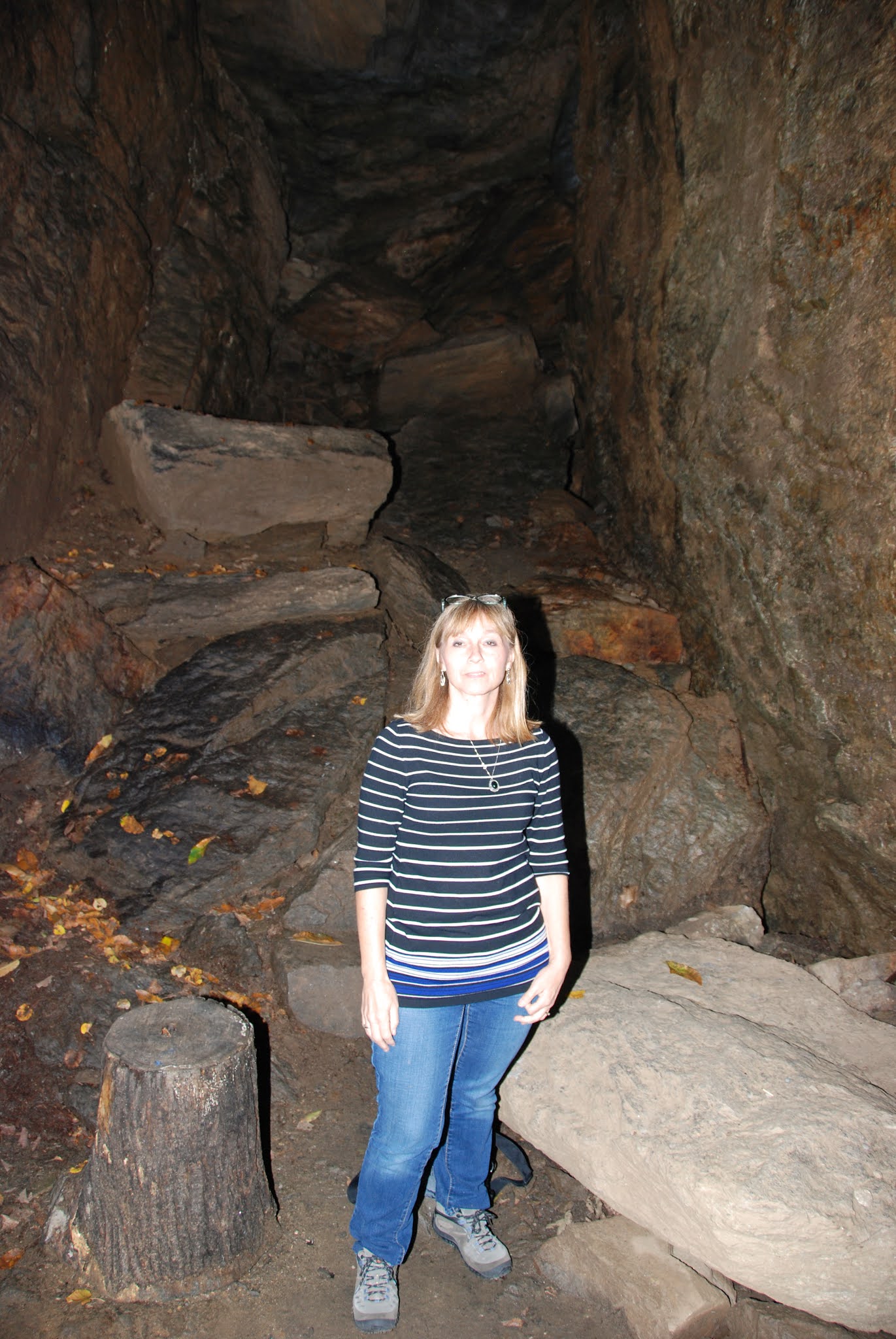
Cave of Faith, Angrogna Valley

 Explanation of the Cave

Their story became the impetus for my contemporary romantic suspense series I self-published in 2015 and 2018. I wanted to create compelling circumstances for my protagonists in the present that mimicked a need to finish the race as their ancestors had done through their enduring faith and courage in the past.

A remnant of Waldensians still exists in their home valleys in Italy. They welcome visitors to step into the past and discover their historical roots. You can learn more about them at the foundation office or Chiesa Valdese. They would be more than happy to answer your questions. 

But one doesn't have to go that far if they live in North America. A community of Waldensians lives in Valdese, North Carolina. Each summer they reproduce their history in an outdoor amphitheater where they present the drama From This Day Forward. They've also constructed to scale an outdoor replica of the historical sites in Italy on their Trail of Faith. There are also other Waldesnian-related museums as well as things to do at the foot of the Blue Ridge Mountains. Visit their tourist office to get more information.

Mural Telling the Waldensian Story, Town Square, Valdese, N.C. 

                                               Replica of the Cave of Faith, Valdese, N.C.

If you'd like to know more about my contemporary romantic suspense Waldensian Series, you can visit my website at www.donnawichelman.com or go to Amazon.com.

(P.S. Pope Francis made peace with the Waldensian faithful in July 2015, when he asked forgiveness for crimes perpetrated by the church in past centuries.)


Thursday, October 29, 2020

Petra: Why it is Deemed one of the 7 Ancient Wonders of the World

Today, our journey takes us to the Near East to the ancient Nabatean city of Petra. We will be heading south from Amman, Jordan to an area below the Dead Sea. Petra had been on my bucket list for years, so I approached it with great enthusiasm.

Nothing could have prepared me for the breath-taking awe of the 2.7-mile (4.3 km) walk through narrow red sandstone canyons and open spaces. The city is magnificent in scope and astounds the mind to consider how the ancients built their facades, most of which today are burial sites that have survived. They even had a sophisticated system of collecting water and using hydraulics to insure they had a year-round water supply in an arid desert climate.

Donna and husband Jim entering the main avenue of Petra

Nabatean Water Channel to Supply the City

Leaving the Canyon into the Treasury Area

The Treasury

In 2007, more than 100 million people voted Petra as one of the new 7 Wonders of the World. Most people associate this archaeological site with the 1989 film Indiana Jones and The Last Crusade. Still, by far, it's the historical drama that unfolded in the region and the rise of the Nabatean culture that captures the imagination, regarding this once vibrant capital city.

Prior to the 6th century B.C. when the Nabateans first arrived, the region already experienced a colorful history. The Bible recounts in Genesis 25 – 27 that Abraham’s son Isaac had twin sons, Jacob and Esau. A tense relationship existed between them, and because of Esau’s impetuous nature, he lost his birthright. He fled to the area in southwest Jordan between the Dead Sea and the Gulf of Aqaba and established the Kingdom of Edom. (Of note: Esau's name and Edom both mean "red" in Hebrew--Esau's complexion having been ruddy and the region composed of red sandstone.)

During the Exodus (most accepted to be around 13th - 12th century B.C.), the route taken by Moses led them through Edom. A place here has been marked as the rock that Moses struck and drew water from in Exodus 17 and is called Moses' Spring or Ayoun Mousa.

Edom thrived between the 13th to 8th centuries B.C., most notably controlling the King's Highway and collecting tribute from traveling merchants. However, in the next two centuries, Edom experienced a period of decline until the sixth century when the Babylonians demolished it--a biblical prophecy foretold long before Edom's downfall. (See Jeremiah 49:7 - 22, Ezekiel 25:12 - 14; 35:1 - 15, Amos 1:11 - 12, Isaiah 21:11 - 12, and Obadiah 1:1 - 14.)

Beginning in the sixth century B.C., the Nabateans--a Bedouin nomadic tribe--migrated from Arabia. Over time, they gave up the nomadic lifestyle, gained the Edomites' lucrative trade routes, and carved edifices into the red sandstone region, most predominantly in the capital city, they called Raqmu (Petra).

The Royal Tombs

The Nabateans prospered for centuries, acquiring wealth and power as caravan merchants and controlled the Transjordan into Syria. In 2 Corinthians 11:32 - 33, we read that Paul had to sneak out of Damascus in a basket through a window to escape from the ethnarch under King Aretas, who was a Nabatean.

The Nabateans maintained a peaceful co-existence with Rome for several centuries until 106 A.D., when Rome took complete rule of the region. Earthquakes in 363 and 747 A.D. severely damaged Petra, and the Bedouin who remained protected Petra from outsiders for more than 1,000 years.

Then in 1812, a Swiss explorer, Johann Ludwig Burckhardt, took on the alias of a devout Muslim, and under the auspices of making a pilgrimage was given access to the ancient city. He published his find, and slowly Europeans flocked to see the wondrous site. The deception caused a great disdain for foreigners by the Bedouins for many years afterward.

Today, the Bedouin welcome visitors to the region, selling their wares along the avenue of a city that once was a thriving metropolis. It is truly worthy of being called one of the 7 Wonders of the World.
Donna in the Background, Surveying the Souveniers


Wednesday, October 21, 2020

Guadix: A City of Cave Dwellers in Southern Spain

Have you ever wondered what it would be like to live underground? 

Today in my History, Travel, and Adventure Blog, I switch directions back to Europe and take us to a lesser-known, but no less fascinating place in the Andalucían province of Granada, Spain.
 
Located on a plateau at almost 3,000 feet (913 meters) in the shadow of the Sierra Nevada is the city of Guadix. The city’s history goes back to ancient Roman times, and sources say Julius Caesar founded Guadix to mine the craggy ochre hills for silver. He called the town Julia Gemella Acci, and residents today are still called Accitanos.

However, it’s the Barrio de las Cuevas or Neighborhood of Caves that draws awe and wonder and compels one to stop and stare and explore what lays beneath the surface of this community. For amidst a dry, rugged landscape, a moon-like topography dotted with white chimneys, poking through the earth, gives evidence of a people known as the troglodytes, who have made their homes in caves for more than five hundred years. But what drove them underground?

Barrio de las Cuevas  

Barrio de las Cuevas

From the 8th to the 15th centuries, much of Spain was under Moorish rule. After several civil wars, Guadix became an important capital of a Moorish kingdom under El Zagal at the end of the Nasrid Dynasty. But in 1492, Granada fell to Catholic Spain, and the town was conquered. At the beginning of the seventeenth century, the Moors were expelled from Spain, and it's said that many took refuge in the caves around Guadix.

Today, almost 19,000 people live in Guadix, many of them inhabiting 4,000 caves as permanent homes in and closeby to the town. An attraction to living underground is a year 'round temperature of sixty-six degrees Fahrenheit (19 degrees Celsius) in an arid climate that can reach the high 90s F in summer (35 c) and get down to the low 20's (-6 c) in winter. Rather than a dank, dark environment, the caves have been modernized, some of them turned into luxurious dwellings, and some have even been converted into hotel accommodations for visitors who would like the experience. The area is considered to have the biggest concentration of inhabited caves in Europe. 

When we visited, my friend Cristina and I toured one of the caves, owned by a sweet man whose name is Jose. Friendly and excited to show us through his home, he led us through quite comfortable and homey rooms that include an up-to-date kitchen, living room, dining room, bathroom, and displayed pictures of his family. When we asked if he would live anywhere else, he said no. His ancestors have lived in this particular cave for generations, and he couldn't imagine living anywhere else. And I can see why. He has everything he needs, and then some.


Jose Welcoming us at the Front Door

                                                          The Front of Jose's Home

Donna in the Foyer of Jose's Home

Jose's Living Room

Jose's Neighbor's Home

Besides the intriguing Barrio de las Cuevas, Guadix boasts an impressive cathedral in the heart of the city that combines the three centuries (16th - 18th) of Gothic, Renaissance, and Baroque styles that it took to erect it and the ochre-colored fortress or Alcazaba de Guadix built during the tenth and eleventh centuries by the Moors. Both testify to the captivating contrast of cultures that have contributed to molding Spain into what it is today. 


Left: Guadix Cathedral, Right: Alcazar de Guadix


Wednesday, October 14, 2020

Dingle, Ireland to Georgetown, Colorado and the Rocky Mountains, Part II

Last week, I began a new blog series, focusing on historical and cultural sites around the world that have captivated my interest. I began with a two-part series “From Dingle, Ireland to Georgetown, Colorado,” exploring the Dingle Peninsula where my protagonist, Anna Katherine O’Sullivan had come from in my Singing Silver Mine Trilogy. Today, I’m exploring the glorious majesty of the Colorado Rockies, the immigrants who came to tame them, and the people who populated the territory before the white man moved in.

 While the Dingle Peninsula of County Kerry had the tallest mountains in all Ireland, the tallest peak only rose to thirty-four hundred feet. Yet, as Anna rode south to Denver aboard the Denver Pacific Railway from Cheyenne, Wyoming in October, she would have seen mountains rising to more than fourteen thousand feet formed in ages past by tectonic and glacial activity. Her eyes must have grown as wide as the grand peaks she saw. She wouldn’t have been the first European to feast her eyes on those peaks, however.

View of the Continental Divide from Brown  Mountain near Georgetown--Summer
In the mid-nineteenth century, many of these mountains were denuded to build mines and housing.

                            View of the Continental Divide from Rocky Mountian National Park in October

The Spanish Conquistadores occupied Colorado in the seventeenth-century and annexed it into the province of Santa Fe de Nuevo México as part of the Viceroyalty of New Spain.  It wasn’t until 1846 when the United States went to war with Mexico that a treaty was finally reached in 1848, giving the territory to the United States.

Most white settlers avoided the rugged terrain, until 1858 when a party from California discovered gold around Pikes Peak. More than one thousand people converged on the Territory of Colorado to find gold. Within a decade, hard rock gold, silver, and other minerals, including coal, gave impetus for prospecting. Some grew rich; most didn’t. Immigrants from Scandinavia, Scotland, Ireland, Italy, Germany, and Russia provided labor for mining, railroads, and farming. Experts in mining technology from Europe flocked to exploit the land. In August 1876, Colorado officially became the thirty-eight state of the union.

When the Spanish first arrived, they set up a system of trade with Native Americans, and between 1832 - 1856 traders, trappers, and settlers established trading posts along the Arkansas, South Platte, and Sain Vrain Rivers, carrying on a robust trade. Most prominent among them were the Cheyenne, Arapaho, and Ute who lived on the plains and moved west along the Front Range of the Colroado mountains, or in the south near New Mexico. These people had their own colorful culture, customs, and religious traditions.

Yet, with immigration came increased pressures for land and resources. Native Americans were pushed off their lands, their sacred burial grounds trampled, diseases like tuberculosis raged through their tribes, and treaties were signed and broken. Cheyenne and Arapaho joined forces against the calvary as skirmishes took place, the two deadliest being the Sand Creek (1864) and Summit Springs (1869) against the Native Americans. Though eventually Native Americans reluctantly accepted reallocation to reservations, strife continued through the twentieth century. 

In the twenty-first century, great strides have been made to educate people about Native American culture and traditions, such as the Denver Indian Market & Southwest Art Fest held every January to bridge the gap. If the history of humanity teaches us anything, it ought to be to value and respect all human life, created in the image of God, wherever it may be found.

Former Site of Arapaho Camp Ground along the Cache La Poudre River, Fort Collins, CO

Alleged Site of Arapaho Council Tree, Cache La Poudre River, Fort Collins, CO


Wednesday, October 7, 2020

New Blog Series Travels to the Past and Explores Our History

Do you enjoy an adventure? Are you fascinated by people, places, and history? When you travel, do you find yourself exploring every nook and cranny of a place, talking to locals and learning about the culture? When you read books, do find yourself gravitating towards non-fiction on times and eras and events that took place in the past? Or if you read fiction, do you tend to get embroiled in historical novels that bring the past to life?

If you've answered yes to any of these questions, you may find my new blog series resonates with you. Every Wednesday, I will post a piece that explores sites around the world that have captivated my interest because of their unique culture or history. Sometimes I'll address a place or people in one of my novels. Other times, I'll talk about a place, monument, or site on one of my travels that struck me as unique or different. And if you've visited a place you think others might want to learn about, I invite you to write a 350 - 500-word piece as a guest blogger.

Today is the 7th of October, so it's fitting to start with two places that are near and dear to my heart because both are dear to the heart of Anna Katherine O'Sullivan in my new Singing Silver Mine Trilogy. Anna emigrated from Dingle, Ireland in the fall of 1872 to live in the Colorado Rockies and arrived in Georgetown on October 7th. She left the love of her life and the only land she'd ever known because the Irish system of landholding made it impossible for a woman born of poverty to marry well without a dowry, and her aunt in Colorado promised her vast opportunities for life and love waited for her there. But what had she left behind?

The Dingle Peninsula--that remote mountainous finger of western Ireland, jutting into the Atlantic Ocean--is most often associated with the Great Hunger of 1845 - 1851 when the potato blight tragically killed more than a million people in all Ireland by starvation, County Kerry being one of the hardest hit.


Long before the nineteenth century, however, various tribes lived on the Dingle Peninsula for more than 6000 years, passing along their myths and folklore in the ancient Irish language. The peninsula boasts a rich and complex archaeological history with more than 2,000 monuments preserved through the millennia. A several-hour tour along the circular route of Slea Head Drive, beginning and ending in Dingle, provides a most spectacular scenic journey through wild landscape, remote Irish-speaking villages, and historic cultural and archaeological sites. 


The Dingle Peninsula provides you with a sense of awe and inspires the imagination. You can easily understand how hard it would have been for Anna to leave her beloved land.

Next week, I'll explore the grand and glorious majesty of the Colorado Rockies, the immigrants who came to tame them, and the people who populated it long before the white man.